

At the conclusion of the disappointing 2025 campaign, MLB.com beat writer Mark Bowman proposed five key priorities for the Atlanta Braves to pursue ahead of the 2026 season:
- Secure an everyday shortstop
- Add depth to the starting rotation
- Address the managerial vacancy
- Reinforce the bullpen
- Bolster the bench as insurance against injury concerns
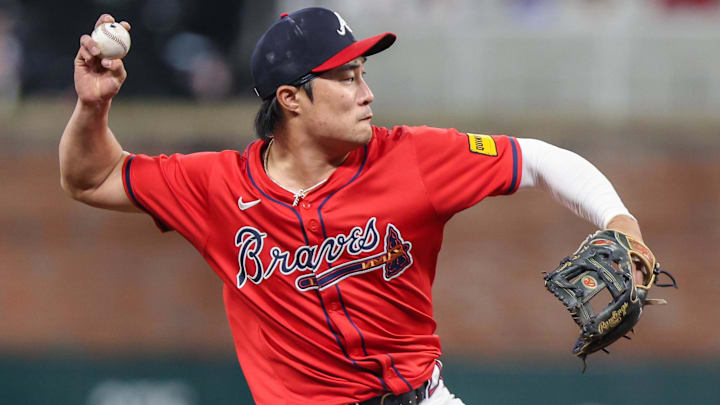
With yesterday's signing of Shortstop Ha-Seong Kim, the Braves have addressed all but one of these offseason priorities. Of course, the first thing the Braves announced this offseason was the hiring of Walt Weiss as the team's new skipper.
By signing closer Raisel Iglesis and flame-thrower Robert Suarez, the Braves acquired one of the best late-inning pitching duos in all of MLB.
Furthermore, the trade for Mauricio Dubón and the free agent signing of Mike Yastremzki provided a high-upside insurance policy for Braves players who battled injuries in 2025: infielders (Ozzie Albies, Austin Riley) and outfielders (Ronald Acuña Jr.) alike.
Clearly, it's been a busy offseason for the Atlanta Braves, and fans should expect at least one more quality move this offseason: the addition of a starting pitcher.
Braves Must Targeted Another Starting Pitcher
Assuming health, the Braves have a formidable starting rotation in 2026: Chris Sale, Spencer Schwellenbach, Spencer Strider, and some combination of Grant Holmes/Reynaldo Lopez/Hurston Waldrep.
If 2025 taught Braves fans anything, it's that health is an unsafe assumption to make about Atlanta's starting rotation. Other than Waldrep (who had his own long-term injury scare in 2024), each of the aforementioned players spent time on the 60-Day IL last season. As I previously wrote, "Bryce Elder led the Braves in the number of games started (28), even while posting a 5.30 ERA, 4.66 xERA, and 4.55 FIP."
The Braves' next offseason priority is to bolster the starting rotation with a highly durable starting pitcher who can eat innings in the middle of Atlanta's rotation. Here are three possible names that fit the bill and could find themselves in a Braves uniform in 2026.
3 Starting Pitchers for Braves to Pursue Next
1. Nathan Eovaldi, RHP

It's been widely reported that the Texas Rangers are searching for ways to trim payroll ahead of the 2026 season. According to Baseball Reference, Nathan Eovaldi is set to command an average of $25M/season for the next two seasons. Eovaldi is exactly the sort of pitcher the Braves would like to acquire this offseason. He is durable (having made at least 20 starts each year since 2021).
He is effective (his career ERA is 3.89, and his career FIP is even better at 3.75). Finally, at $25M/season for only two seasons, he is the type of short-term contract the Braves have historically preferred. Don't be surprised if the Braves try to broker a trade deal to bring Eovaldi to Atlanta ahead of the 2026 season.
2. Chris Bassitt, RHP
Chris Bassitt is a free agent who did not receive a qualifying offer, meaning that the Braves would be free to sign him without giving up prospects or draft capital. He has made at least 30 starts since the 2022 season, and based on past performance, can be reasonably projected to both an ERA and a FIP in the high 3.00/low 4.00 range. While his ceiling may not be as high as Eovaldi's, his cost would be much lower: Just Baseball projects Bassitt to receive a one- or two-year contract with an average annual value of $12M to $18M.
Combined with his track record of durability, this short-term, affordable contract makes Bassitt an especially appealing free agent for the Braves to pursue.
3. Brad Keller

The Braves have a track record of converting relief pitchers to starting pitchers, with Grant Holmes and Reynaldo Lopez being two of the most recent examples. Why move away from a winning strategy?
As a reliever for the Chicago Cubs last season, Keller made 68 appearances and pitched to a 2.07 ERA (2.93 FIP), which was good for 1.4 WAR. Keller once started as a member of the rotation for the Kansas City Royals, and many in baseball project him as a starter in 2026. Signing Keller as a projected starter carries a fair amount of risk, but it would be a way for the Braves to potentially add an innings-eater at a reliever's price; Keller is projected to receive a 2-year, $22M contract, per Yahoo Sports. It's the sort of low-cost, high-upside move that fits right into the wheelhouse of general manager Alex Anthopolous.
Adding Another Starting Pitcher is a Multi-Layered Move
Obviously, adding a durable innings-eater provides valuable depth to Atlanta's starting rotation and protects against a repeat of 2025 (in which Carlos Carrasco, Erick Fedde, and Cal Quantrill all made starts for the Braves. The addition of a starting pitcher would also strengthen Atlanta's bullpen.
With an extra arm in the rotation, pitchers like Grant Holmes and/or Reynaldo Lopez could step back into high-leverage relief rolls. At a minimum, players like Elder and/or Joey Wentz could be deployed in mop-up duty, rather than as starters in crucial regular-season games.
Adding a starter is the last of Bowman's preseason priorities left for the Braves to address, and doing so would improve the team on multiple fronts. Such a move is a crystal clear final offseason priority for the Braves to make before the start of the 2026 season.
More Atlanta Braves News & Rumors:
 Add us as a preferred source on Google